
This post is part of a weekly series reviewing higher-education websites through the lens of prospective students and families, focusing on the information they need from a website and how well institutional sites help them find it. Reviews are published in a spirit of collegiality and support. If you notice an inaccuracy or have an issue with a website review, please get in touch.
See more college and university website reviews.
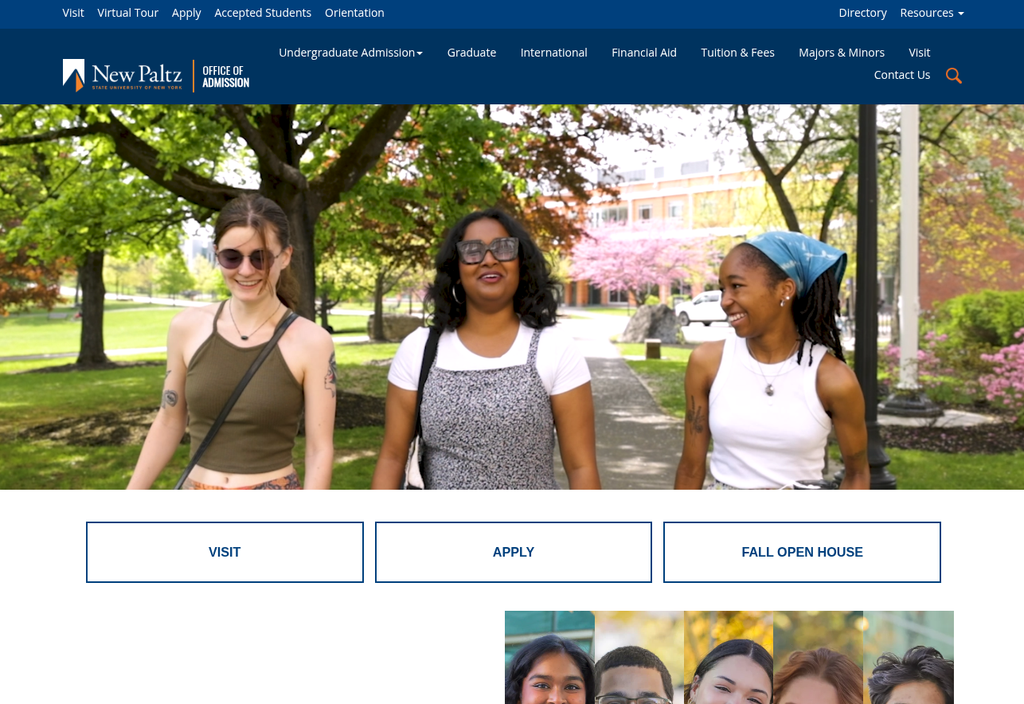
This SUNY New Paltz website review looks at the undergraduate admissions experience from two vantage points: a high school senior weighing options in the Hudson Valley area, and the parent helping that student make a sound decision. The New Paltz Admission page greets both with a warm invitation, “Come As You Are,” and backs it with real substance. A current, clearly formatted cost of attendance page and automatic merit scholarships are among the most useful resources in the series so far. The opportunity is proximity. Several of the answers families need most sit one step outside the admissions pages, where it sends the user flow to a new section of the site.
SUNY New Paltz at a glance
- Location: New Paltz, New York, in the Hudson River Valley
- Type: Public, comprehensive college in the State University of New York system
- Founded: 1828
- Total enrollment: 7,898 (IPEDS, 2024)
- Athletics: NCAA Division III Hawks, New Jersey Athletic Conference (beginning 2026-27)
Summary of SUNY New Paltz Website Review
Clear strengths
- A 2026-27 cost of attendance page published as a true text table, with resident, non-resident, and commuter columns, per-semester totals, and a plain note that the budget is not a bill.
- Merit scholarships are awarded automatically with the application, with amounts and GPA ranges laid out in a single table, including dedicated awards for New Jersey and other out-of-state students.
- The first-year admission page gathers requirements, deadlines, application options, visits, and accepted-student steps in one place.
- Both the SUNY Application and the Common App are offered side by side, with a clear note that the process and fee are the same.
- A warm, human admissions voice, student story videos, and an interactive Hudson Valley map give families a feel for place, not just process.
Strategic opportunities
- The cost of attendance page and net price calculator live on the financial aid site and are not linked from the admissions Financial Aid page, so a family starting in admissions has to take extra steps find the information.
- Admissions pages resolve on two hostnames, www.newpaltz.edu and terminal.newpaltz.edu, and both appear in search results. This should be an easy fix with DNS or redirection rules.
- Some admissions copy carries dated references, including a 2014 statistic under Points of Pride, a profile “as of August 2020,” and test-optional language tied to Fall 2024 and Spring 2025.
- Program discovery is a static list of roughly 66 entries under an introduction promising “nearly 100” majors. Scanning it for a specific interest took longer than I expected.
- Parents of prospective students have no dedicated starting point; the Parents and Families site primarily speaks to families of current students.
Technical foundations
SUNY New Paltz runs on the TerminalFour content management system, the first in this series, based on the TerminalFour login link. URLs mix static .html pages, .php pages for student accounts, and extensionless paths, a common pattern on a long-lived site that has grown in stages. Inquiry forms, visit registration, application status, and the graduate application run on a separate admissions.newpaltz.edu subdomain, with URL patterns typical of a CRM portal. Applicants then leave for the SUNY Application or the Common App.
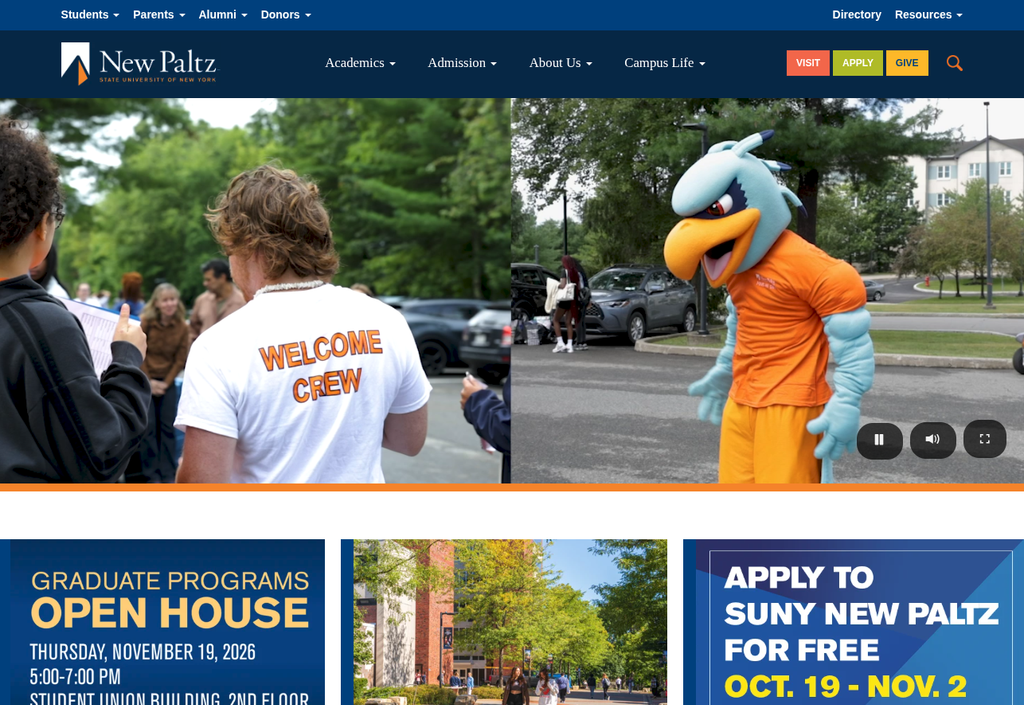
Admissions pages are reachable at both www.newpaltz.edu and terminal.newpaltz.edu, and the admissions sub-navigation on the terminal host points to terminal URLs. Both versions appear in search results, which may create competing rankings and indicate a technical configuration concern. It should be easy to fix with a DNS update or redirection rule. A number of internal links also still use http rather than https. Neither issue is visible to most visitors, but both can divide search visibility between two copies of the same page.
Lighthouse results tell an interesting story. On desktop, the admissions landing page outscores the home page on performance (88 to 80), even though it carries a hero video, an interactive map, and a carousel. On mobile, the order reverses and both pages drop: home falls to 65 and admissions to 60, a 28-point decline for the page prospective students are most likely to open on a phone. Best Practices (73) and SEO (92) are identical across all four tests, which suggests template-level items that a single fix could lift everywhere.




Information architecture and findability
The admissions sub-navigation is well chosen. First-Year, Transfer, Readmission, Merit-Based Scholarships, Graduate, International, Financial Aid, Tuition & Fees, Majors & Minors, and Contact Us cover what a prospective family typically looks for, and Visit, Request Info, and Apply repeat in consistent places. The landing page leans toward a hub of cards and audience links, which serves returning visitors well. A first-time visitor gets short statistics and highlights, with depth a click or two away.
The first-year page is the strongest page in the admissions section. Requirements, deadlines (Early Action November 15, fall May 1, accelerated 3+4 medical and optometry January 15), home-schooled and veteran guidance, visits, and accepted-student steps all sit together. A few small items reduce polish: duplicate raw URLs to the SUNY Application inside link text, two links pointing to the same early action anchor, and SAT and ACT wording for the accelerated programs that could create confusion. The Apply page refers to FAQs “below” that do not exist on the page.
Program discovery is the larger findability opportunity. Majors & Minors is a static list grouped by school, with roughly 66 entries linking to the online catalog. The page introduction mentions “nearly 100 undergraduate majors” and the landing page cites 100 undergraduate programs, so a student may wonder what is missing. Some programs appear twice or under two schools, and there is no search or filter. For a student who knows an interest but not a major name, the current format requires patience and effort to find a match.
Cost, financial aid, and transparency
Cost is often the center of a family’s decision, and New Paltz provides the necessary information in a user-friendly format. The 2026-27 cost of attendance page is current, dated (“as of June 2026”), and published as an accessible text table. A New York resident living on campus can see a total of $31,329 for the year, a non-resident $41,929, and a commuter living with family $18,565, each broken into tuition, fees, housing, meals, books, transportation, and personal expenses, with per-semester figures alongside. Few sites in this series answer the cost question this cleanly.
The opportunity is in the path to that page. From admissions, the Financial Aid link opens an admissions summary with FAFSA and TAP school codes but no cost figures and no net price calculator. It sends readers to the main financial aid site, where Cost of Attendance and the Net Price Calculator sit in the menu. The admissions Tuition & Fees link goes to the student accounts office, which is written for students already receiving bills. A parent starting in admissions can reach the right answer, but has to know where to look.
Merit scholarships are a genuine strength. Students are reviewed automatically with the SUNY Application or the Common App, and awards range from $2,000 to $6,000 per year, renewable. The State Line Presidential and Garden State Rising Scholars awards speak directly to out-of-state and New Jersey families. One small item needs attention: the GPA thresholds in the summary table differ slightly from those in the details below it, and the page does not name an academic year.
Accessibility, usability, and inclusivity
New Paltz publishes an accessibility policy covering all newpaltz.edu sites and subdomains, an accessibility plan, and a “Report an Accessibility Issue” link in the global footer, along with a stated two-business-day acknowledgment window for time-sensitive requests. That is a mature, visible posture. The policy references WCAG 2.0 Level AA, an older standard, and notes that SUNY will adopt later versions over time.
Accessibility scores range from 86 to 94, with the admissions page on mobile lowest at 86. The cost table is a model of accessible data presentation. Smaller items, such as a search icon linked to “#” with no label and images with minimal alt text, are worth a look. The “Come As You Are” message, student stories across a range of majors, and a dedicated Veterans and Military path make the site feel welcoming to a broad set of students.
Executive lens: enrollment, risk, and governance
Enrollment and funnel. Visit, Request Info, and Apply are consistent and prominent, and automatic merit review removes a step many institutions still require. The regional scholarships suggest a deliberate out-of-state recruitment strategy, which makes the cost path more important: families comparing New Paltz with schools in their own state need the non-resident total and the net price calculator close at hand. The mobile performance of the admissions page also matters here, since that is where many prospective students first arrive.
Risk and compliance. The accessibility policy, plan, and reporting path place New Paltz in a strong position. Dated statistics and time-bound language carry modest reputational risk, since a family reading a 2014 figure on the Points of Pride may wonder what else is current. The duplicate hostname is primarily a search and consistency concern.
Governance and maturity. The site shows the layers of a long-lived institutional web presence: .html, .php, and extensionless paths, http and https links, www, www3, and terminal hosts, and a 2011 page on a former athletics domain still linked from the first-year page (arrives to a 404 page). None of this is unusual, and the TerminalFour platform supports consolidation. The cost page shows what the institution can do when content is owned and kept current.
Recommendations
- Link the 2026-27 cost of attendance table and the net price calculator directly from the admissions Financial Aid page and the admissions landing page. Consolidate the information under one section (if possible) in order to support the new student journey in one section of the site.
- Point the admissions Tuition & Fees link to the cost of attendance page, which is written for prospective families, rather than to student accounts.
- Consolidate admissions pages on a single hostname, with canonical tags and https throughout.
- Refresh dated statistics and time-bound language, and add the academic year to scholarship and test-optional content.
- Update the broken 2011 link to the current page for the First Year Outdoor Trip.
- Rebuild Majors & Minors as a searchable, filterable program finder whose count matches the “100 programs” message.
- Add a short page for parents of prospective students that brings together cost, aid, scholarships, visits, and safety.
- Focus mobile performance work on the admissions landing page, where the hero video, map, and carousel load on smaller devices.
An invitation to collaborate
This series exists to share what prospective students and families experience on institutional websites and to support the teams working hard to serve them. Every site reviewed here reflects real constraints, real people, and real progress. If your institution is working through questions like these, or you would like a deeper, institution-specific look at your digital experience, we would welcome the conversation.
Want to work together? Get in touch.
Disclaimer: This review is based on publicly available information at a specific point in time and reflects professional opinion offered constructively. Websites change frequently, and details may have shifted since publication. Institutions are welcome to submit corrections or updates, which will be incorporated promptly.